

Fed Holds Rates Steady in 9-3 Divided Decision: US Dollar Plunges Below 100 Threshold
As internal Fed dissents surface over persistent inflation risks, market participants interpret Chair Warsh’s commentary as dovish, triggering a broad sell-off in the US dollar index and reshaping foreign exchange expectations.
The Federal Reserve concluded its July 2026 Federal Open Market Committee (FOMC) meeting by maintaining the benchmark federal funds rate at 3.50% to 3.75%. However, beneath the surface of this rate hold lies a significantly divided central bank board, passing by a 9–3 vote with three regional Fed presidents dissenting in favor of an immediate 25 basis point hike.
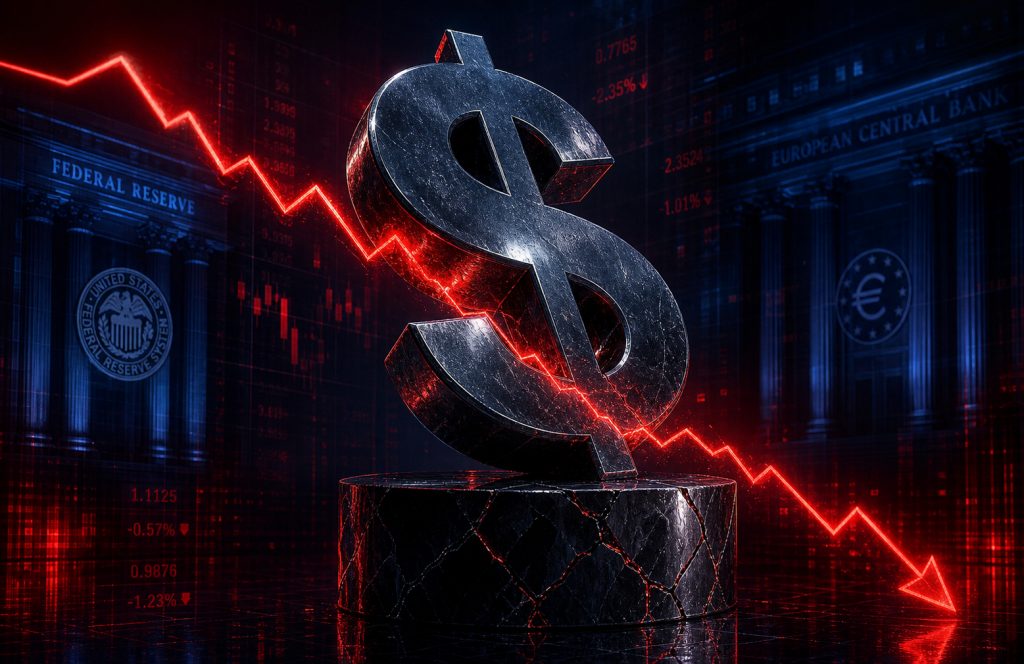
Despite the split vote and lingering inflation concerns, global financial markets reacted to post-meeting communications with a distinctly dovish interpretation. The lack of explicit forward commitment to a September rate increase ignited a sharp sell-off across US dollar assets, causing the US Dollar Index (DXY) to drop below the critical 100 mark for the first time in months. This realignment has profound implications for global trade financing, cross-border capital flows, and foreign exchange strategies.
KEY DRIVERS OF THE DOLLAR’S ACCELERATED DEPRECIATION
The sharp downward trajectory of the greenback following the July FOMC meeting stems from a convergence of macroeconomic signals:
1. Dovish Interpretation of “Hawkish Hold”
While three Fed members—Beth Hammack, Neel Kashkari, and Lorie Logan—voted against the pause to demand higher rates, market participants focused heavily on the broader consensus. Chair Kevin Warsh highlighted solid economic growth while refraining from signaling an imminent autumn rate hike, leading traders to price in a prolonged policy plateau rather than further tightening.
2. Plunge in US Treasury Yields
Following the policy announcement, short-to-medium term US Treasury yields experienced a rapid pullback. As yield differentials between the US dollar and other major currencies narrowed, carry trade incentives weakened, encouraging global funds to reallocate capital into higher-yielding emerging market currencies and beaten-down major pairs.
3. Resilience in Broader Global Economies
The dollar’s slide was further compounded by improving macroeconomic indicators in Europe and Asia. As inflation dynamics gradually normalize globally, central banks outside the United States are finding firmer footing, reducing the relative safe-haven premium that supported the greenback throughout earlier geopolitical friction.
HISTORICAL CONTEXT: FOMC DISSENTS & CURRENCY IMPLICATIONS
Multi-member dissents at FOMC meetings are historically rare and usually signal upcoming inflection points in monetary policy cycles. In the July 2026 meeting, while the benchmark rate was kept unchanged at 3.50% to 3.75%, the 9-to-3 voting tally underscored deepening policy divisions. Officials Beth Hammack, Neel Kashkari, and Lorie Logan formally recorded their preference for a 25 basis point rate increase, citing persistent service-sector inflation.
Despite these hawkish dissents, currency markets prioritized the overarching dovish tone set by the leadership, driving the US Dollar Index below 100.00. Historically, strong internal dissents for higher rates initially create short-term volatility. However, when foreign exchange markets perceive that central bank leadership is reluctant to lead an aggressive tightening cycle, investors prioritize yield trajectory over minority policy dissents.
POLICY DILEMMA FOR CENTRAL BANKS WORLDWIDE
The weakening US dollar presents a complex set of economic trade-offs for monetary authorities across the globe:
For export-driven economies such as Japan, China, and the Eurozone, a stronger local currency against the dollar threatens to reduce export competitiveness and weigh on corporate earnings.
For energy and commodity-importing nations, a weaker dollar offers welcome relief. Because crude oil and raw materials are primarily priced in greenbacks, the currency slide reduces domestic import costs and helps mitigate local inflationary pressures.
For emerging market debtors, a depreciating dollar lightens the financial burden of servicing US dollar-denominated sovereign and corporate obligations, reducing systemic credit risks across international capital markets.
With the dollar breaking key technical support levels, central banks in emerging markets are gaining expanded flexibility to adjust domestic interest rates without the immediate fear of triggering capital flight.
INSTITUTIONAL OUTLOOK & STRATEGIC IMPLICATIONS FOR INVESTORS
In the short term, over the next one to four weeks, market participants should anticipate heightened volatility across major pairs including USD/JPY, EUR/USD, and GBP/USD. Foreign exchange markets will remain extremely sensitive to upcoming US Non-Farm Payrolls and Consumer Price Index releases, as well as any escalations in Middle East geopolitical developments that could temporarily trigger safe-haven dollar buying.
Over a medium-term horizon of one to three months, the US Dollar Index is expected to test deeper technical support around the 98.50 to 99.50 range. This trajectory will hold unless upcoming inflation data forces the hawkish wing of the FOMC to regain dominance ahead of the September meeting.
Strategic Takeaways for Market Participants:
First, foreign exchange traders should exercise caution around key technical levels on the dollar index pivot. Implementing disciplined risk management and trailing stops is essential given the high sensitivity to economic data surprises.
Second, cross-border businesses can leverage the current currency momentum to structure favorable foreign exchange hedges, locking in competitive rates while the greenback experiences cyclical weakness.
Third, fixed income and commodity portfolio managers stand to benefit, as sustained dollar weakness typically provides fundamental tailwinds for precious metals such as gold and silver, as well as broad commodity benchmarks.
CONCLUSION
The July 2026 FOMC rate hold marks a pivotal moment in macroeconomic policy. Although three dissenting Fed officials pushed for further rate hikes, market sentiment has decisively leaned toward a softer dollar outlook. Until economic data unambiguously demands renewed rate tightening, global currency markets will likely operate in an environment characterized by a weaker US dollar and recalibrated international yield expectations.
Published on 31/07/2026
By Nicholas.